
Comprehension · Ages 2–3, 4–5, 6–8
How Children Understand Stories
Help your child connect what a character wants with what happens. Simple reading-aloud examples, useful prompts, and one optional drawing activity.
Published 16 September 2026 · 4 min read
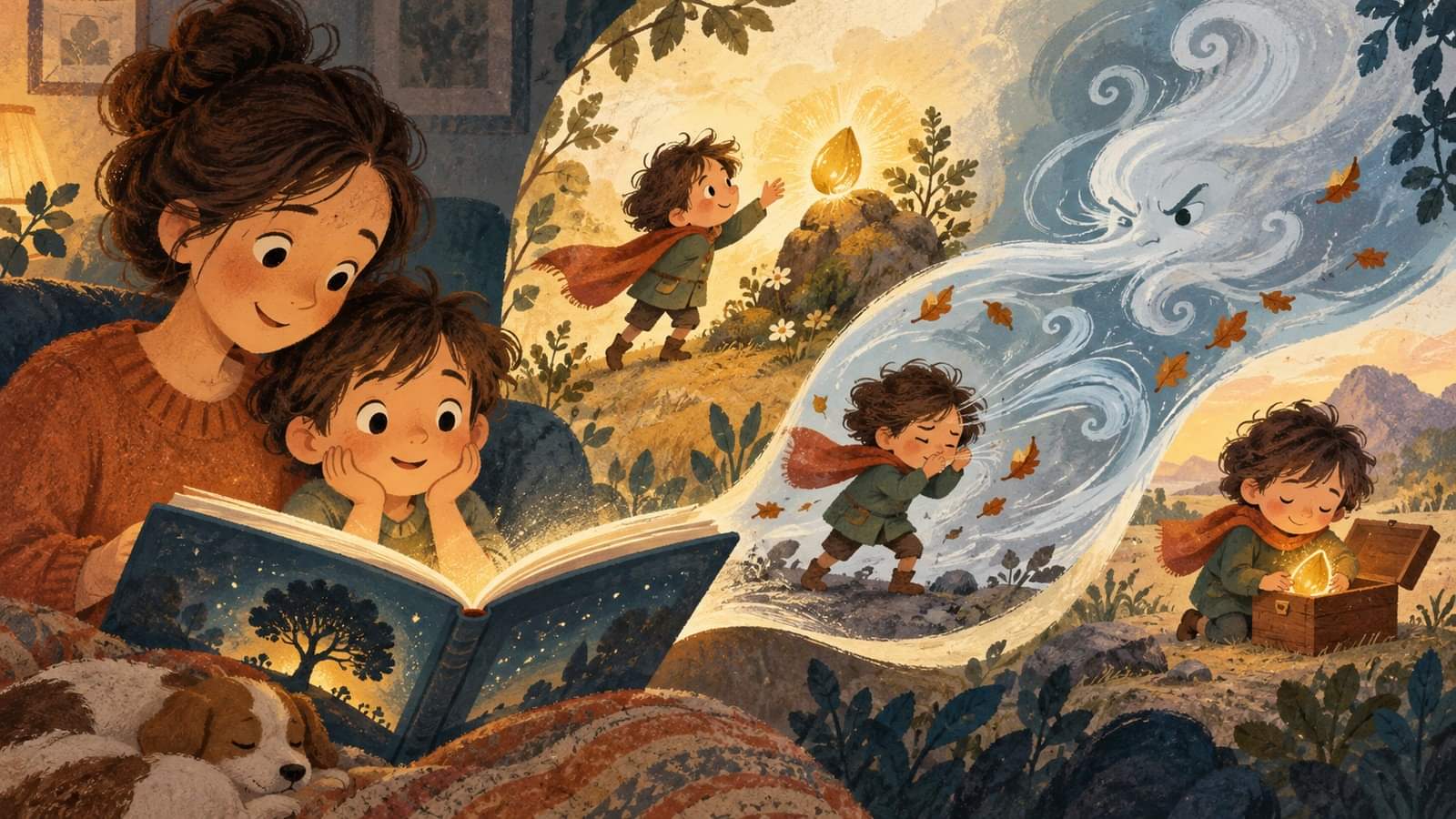
Children understand a story by connecting what happens with what the characters want and do. To help, share one connection aloud: “He wanted to join in, but he couldn't fit through the gap.” You can point to a picture, explain an unfamiliar word, or revisit a scene together. There is no need to quiz your child after every book.
Remembering a funny line is one way to join in. Explaining a character's choice is another. A short answer, or no answer at bedtime, gives you only a small glimpse of what your child understood.
Start with the part your child noticed
If your child talks about a dragon's wings while you are thinking about the ending, begin with the wings. “Yes, they were enormous. What happened when he tried to go through the door?” Or simply offer your own thought and keep reading.
A comment can be enough. You do not have to turn every observation into a question. For more ideas, see our seven reading-aloud tips.
Explain a word when it matters
Sometimes a missing word makes the action hard to follow. If a character “sheltered” some seeds, try: “She put them somewhere the wind couldn't reach.” Then return to the story.
Reading printed words and understanding their meaning are different tasks. Reading researchers describe reading comprehension as the product of the two, word recognition and language comprehension, and a child can be strong in one while still building the other. Simple view of reading A child may understand a passage you read aloud while finding the print difficult themselves. If working out the words is taking all their effort, offer to read a section together. Our guide to the benefits of reading aloud explains that distinction.
Connect what the character wanted with what happened
Pick one clear moment. These three prompts can help you decide what to say:
- What did the character want?
- What got in the way?
- What did they try?
You can supply all three parts yourself. They are a guide for your conversation, not questions your child must answer.
For example, in Benny and the Fox, Benny wants to do what Finn the fox can do. He tries to squeeze through a narrow gap and gets stuck. You might say, “Benny wanted to follow Finn, but the gap was too small for him.” The story is recommended for ages 3–6; choose an age-appropriate picture book for a younger listener.
Show how two events fit together
Putting events in order helps tell what happened. Adding “because” or “so” can help explain the connection.
Here is a short invented example:
Lily takes seeds to the garden. The wind scatters some, so she closes the packet and puts it in her lunchbox.
You could say, “She uses the lunchbox to protect the seeds.” If your child thinks she is having lunch, point back to what went inside. One explanation may be more useful than asking the same question again.
Some stories have no single problem to solve. They might explore a place or repeat a funny pattern. Talk about what changes or repeats instead of making every book fit these prompts.
Leave room for wondering
Stories do not always explain every action. If Lily looks along the path on her way home, she might be looking for the seeds she dropped. Say “might” when the story leaves the reason open.
Your child can have a different idea. Look at the words and pictures together rather than trying to guess the answer the adult wants.
If they would rather listen, carry on. You can return to an interesting moment another day.
Try it together · Storyboat
Optional: draw one story moment
Choose a scene your child enjoyed. Draw what the character wanted on one side of a page and what happened on the other. Stick figures are enough.
Point between the pictures while you tell the connection. Your child can draw, add a word, or simply listen. Stop when you have said what you wanted to share.
What the research adds
The IES guide for kindergarten through grade 3 supports teaching children about story structure and comprehension strategies. Its recommendations have different evidence ratings, and the research concerns classroom teaching. It does not establish that this home drawing activity improves comprehension. IES practice guide
For tonight, choose one word or connection that makes the story clearer. Enjoying the reading together does not depend on completing an activity.
References
- Shanahan, T., Callison, K., Carriere, C., Duke, N. K., Pearson, P. D., Schatschneider, C., & Torgesen, J. (2010). Improving Reading Comprehension in Kindergarten Through 3rd Grade. Institute of Education Sciences, NCEE 2010-4038. Recommendations and Appendix D evidence discussions consulted; classroom scope, with differing evidence ratings across recommendations.
- Gough, P. B., & Tunmer, W. E. (1986). Decoding, Reading, and Reading Disability. Remedial and Special Education, 7(1), 6–10. The “simple view of reading” framework; cited for the distinction between word recognition and language comprehension only.