
Language & learning · Ages 2–3, 4–5, 6–8
Why Does My Child Want the Same Bedtime Story Every Night?
Rereading a favorite is an ordinary storytime choice. Understand what repetition can offer and try three manageable responses, including a limit when you need one.
Published 16 September 2026 · 4 min read
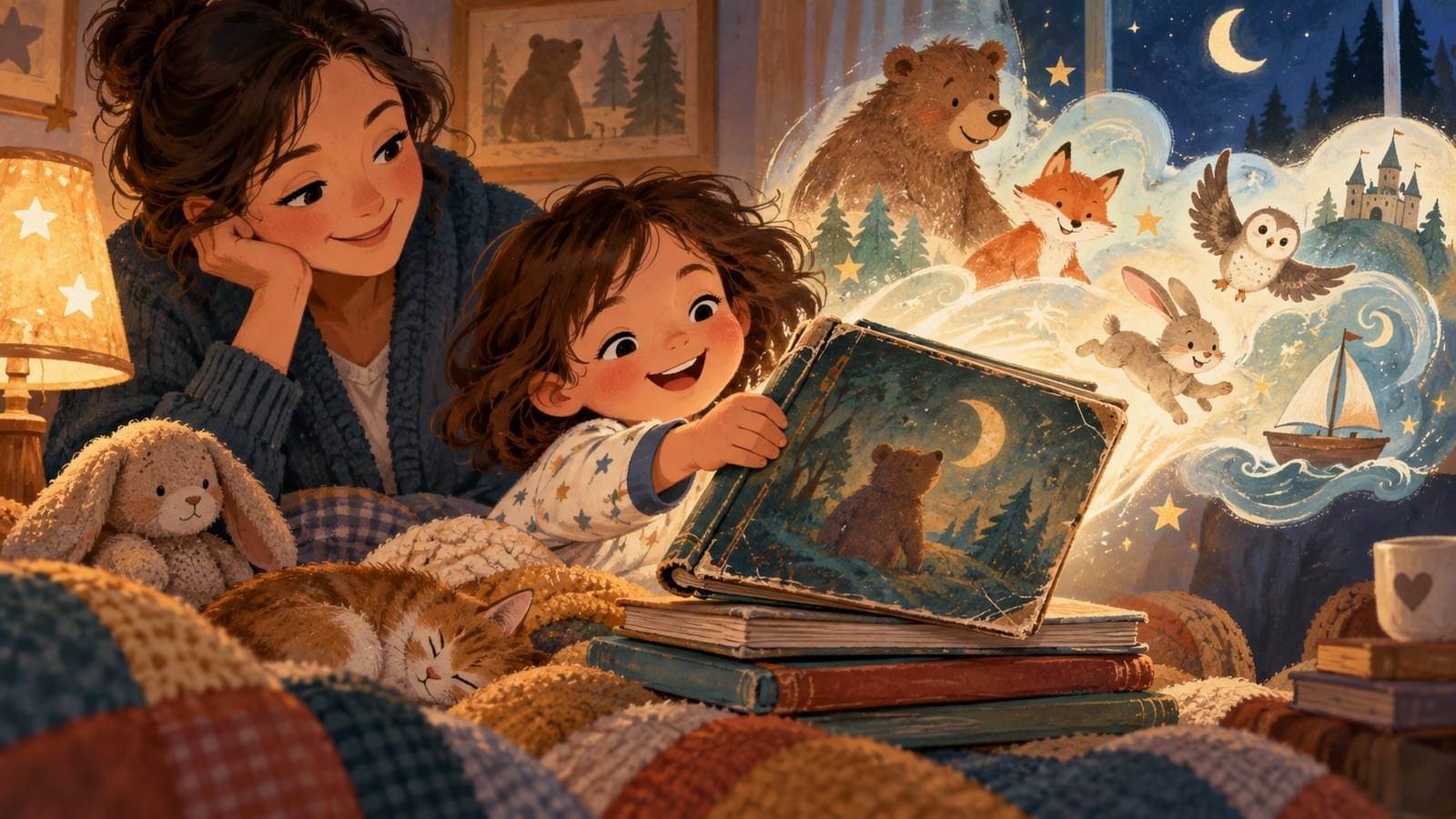
Wanting the same bedtime story again does not mean your child needs a different book or a harder activity. They may enjoy knowing what comes next, joining in a familiar line, revisiting a favorite character, or sharing that particular story with you. You can reread it, keep a reasonable limit, and offer something new another time.
Those are possible explanations, not a way to diagnose why your child makes the request. Start with what they seem to enjoy: the funny page, the ending, or the chance to say a line before you do.
What can another reading offer?
The words and pictures are available again without the work of meeting a new set of characters. Your child can return to a detail they missed, anticipate a joke, or listen to the same events from beginning to end. A familiar story does not need a new assignment to remain enjoyable.
Research also gives one specific reason repetition can be useful. In a small study with three-year-olds, children who heard the same stories repeatedly learned new object names better than children who heard different stories containing those names. This was a word-learning experiment, not a study of why children request bedtime favorites. Repetition study
A broader meta-analysis examined children’s word learning from shared storybook reading, including differences between reading conditions. It supports keeping the discussion focused on word learning, rather than claiming rereading guarantees wider developmental benefits. Research overview
Read the familiar version when it works for you
It is fine to say yes. You might ask, “Would you like to say the owl’s line, or shall I read it all?” If your child wants the exact version they know, you can simply read it.
For example, Benny and the Fox, recommended for ages 3–6, includes Benny trying to fit through a narrow gap. A child might enjoy anticipating that mishap without wanting to discuss its meaning. Letting the funny part stay funny is a complete way to share it.
You can stop after the agreed reading even if your child wants another round. Enjoying repetition does not require repeating a book without a limit.
Offer one small variation, only if they want it
Try a brief invitation: “Shall we look for the rabbits in this picture?” Or explain one word that helps the scene make sense. If the answer is “Just read it,” carry on.
You do not have to change the words or invent a new ending. Some children strongly prefer the familiar version. Variation can be as small as letting them turn the page or choose where you sit.
For more suggested phrases, see our seven reading-aloud tips. The aim is to make room for a contribution, not to collect answers.
Set a limit that works for the adult too
If you have reached your limit, be clear before opening the book. These are example phrases you can adapt:
- “We can read that one once tonight, then it’s goodnight.”
- “I’m ready for a different book. Would you like this animal story or the train story?”
- “Let’s keep your favorite for bedtime and try the new one tomorrow afternoon.”
Choose a limit you can carry out. You can acknowledge disappointment without reopening the whole decision: “You wanted it again. We’ll put it here for tomorrow.”
If the problem is that any book leads to another request, our guide to one more bedtime story focuses on ending the session.
When to offer a new story
Offer it when there is time and interest, rather than making novelty a requirement at bedtime. A new book might share an animal, setting, or kind of humor with the favorite. Your child can hear a little of it, return to the old one, and meet it again later.
For more about the evidence behind sharing books, read the benefits of reading aloud. Tonight, rereading the favorite once and enjoying a familiar ending can be enough.
References
- Horst, J. S., Parsons, K. L., and Bryan, N. M. (2011). Get the Story Straight: Contextual Repetition Promotes Word Learning from Storybooks. Frontiers in Psychology, 2, 17. DOI: 10.3389/fpsyg.2011.00017. Full text consulted.
- Flack, Z. M., Field, A. P., and Horst, J. S. (2018). The effects of shared storybook reading on word learning: A meta-analysis. Developmental Psychology, 54(7), 1334–1346. DOI: 10.1037/dev0000512. Published abstract consulted.