
Comprehension · Ages 3–5, 6–8
Bedtime Stories With Morals: 9 Stories That Teach Without a Lecture
Nine illustrated bedtime stories with a lesson at their heart, sorted by the lesson: sharing, kindness, friendship, courage, checking for yourself, letting go, making room for a new sibling, accepting help and teamwork. None of them states its moral at the end.
Published 20 October 2026 · 12 min read
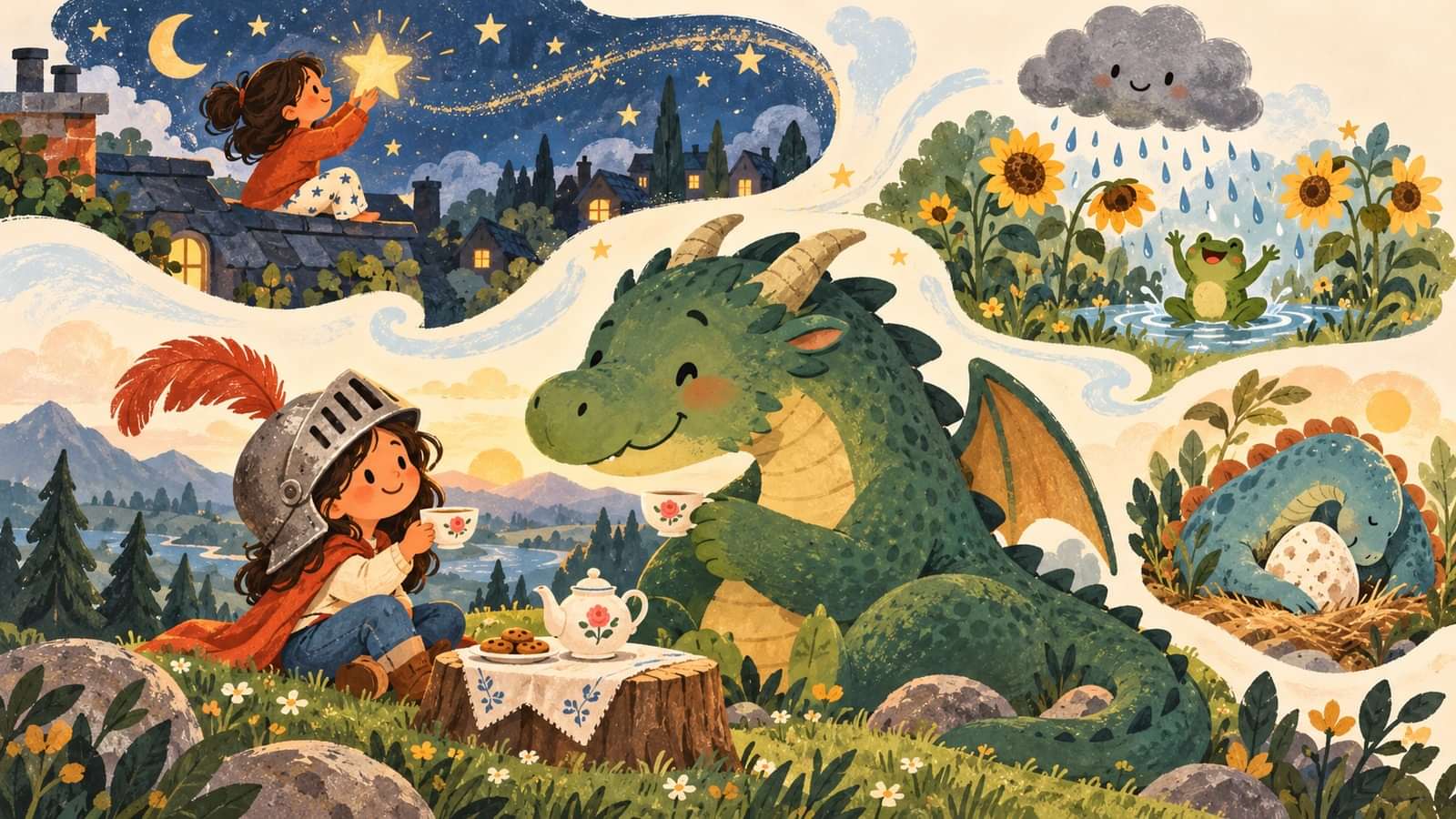
For bedtime stories with morals, choose a story where the character discovers the lesson rather than being told it. Below are nine illustrated stories sorted by the lesson at their heart: sharing, kindness, friendship, courage, checking for yourself, letting go, making room for a new sibling, accepting help, and working together. None of them ends with “and the moral of the story is”. Each one shows the lesson, and the feeling does the teaching.
These are selections from our own illustrated library. Each link opens the story page, where you can see a preview and current availability. Ages and narration lengths were checked in October 2026. For three of the lessons we have a full page of stories: sharing, kindness and friendship.
Sharing: The Cloud Who Would Not Rain
Recommended ages: 3–7 · Narration: 6 minutes
Puff is a little cloud who refuses to rain. The other clouds rain whenever the flowers below get thirsty, but Puff has exactly one hundred raindrops and plans to keep every one. The longer he holds on, the more water he collects, until he is so heavy that he sinks down over a dry garden where the sunflowers are drooping and a frog’s pond has almost dried up. The frog asks him to rain, and Puff says no. Then a bit of sunflower fluff lands on his nose, he sneezes, and all his rain pours out at once. The garden comes back to life, the frog gets his pond back, and Puff, suddenly light, floats up into the sky happier than he ever was while he was keeping everything.
The lesson, shown: giving away what he was holding on to did not feel like losing. It felt like flying. More sharing stories, including Bramble’s Bakery and The Cookie Thief, are in bedtime stories about sharing.
 The Cloud Who Would Not RainPuff is a little cloud with exactly one hundred raindrops, and he intends to keep every one. As he drifts over a parched garden and meets a hopeful frog, holding on begins to feel much harder than he expected.Play the story
Kindness and accepting help: The Lost Kite
Recommended ages: 3–7 · Narration: 5 minutes
Little Bear has spent days making his very first kite, and on the first windy day of the year he finally gets to fly it. Then the string snaps and the wind carries the kite away over the jungle. Bear asks his friends Elephant, Giraffe, Eagle, Squirrel and Beaver to help him search, and each one looks in their own way, but nobody finds it, and Bear goes to bed sad. The next morning his friends knock on his door. Each of them has made him a new kite shaped like themselves (Elephant’s has big floppy ears), so that the windy day can still be special, and they all fly them together.
The lesson, shown: asking for help is brave, and kindness does not always fix the problem you started with. Sometimes it gives you something better. More stories are in bedtime stories about kindness.
 The Lost KiteOn the first windy day, Little Bear sends his very first kite into the sky, only to lose it. As he searches the jungle, this gentle story explores disappointment, hope, and the kindness of friends.Play the story
Friendship and differences: Benny and the Fox
Recommended ages: 3–6 · Narration: 5 minutes
Benny is a baby elephant who wants to be friends with a small red fox. The fox keeps saying no, and each day he gives a new reason: he runs fast, he can squeeze through tiny gaps, and he can move through the forest without a sound. Each time, Benny tries to show he can do it too, and each time it goes wrong in a funny way. He splashes into a mud puddle, gets stuck between two rocks, and stomps so loudly that the whole forest jumps. But every time, the two of them end up laughing together. At last the fox asks why Benny keeps coming back, and Benny says, “Because I like you.” The fox admits he has been having fun too, tells Benny his name is Finn, and they become best friends.
The lesson, shown: friends do not have to be alike. At the end, Finn is still faster and Benny is still louder, and they fit together just right. More friendship stories are in bedtime stories about friendship.
 Benny and the FoxFriendly Benny the elephant keeps meeting a speedy, sneaky little fox, discovering through muddy mishaps and laughter that friendship can grow between the most different animals.Play the story
Courage and seeing for yourself: The Dragon of Butterscotch Hill
Recommended ages: 4–8 · Narration: 6 minutes
Everyone in the village of Fernwick is sure a terrible dragon lives on the hill above them. People say they have seen his smoke, heard his roar and had their cups go missing, so nobody ever goes up. Only one girl, Greta, notices that the stories do not quite make sense: if the dragon breathes fire, why has nothing ever burned? So she puts on her grandfather’s old helmet and climbs the hill to see for herself. The roar turns out to be a whistling kettle and the smoke comes from a little stove. The dragon, Cinders, is gentle and lonely, and he only borrowed the cups because he wanted to hold a tea party. He has been waiting three hundred years for someone to have tea with. Greta stays for tea, and soon the whole village joins them.
The lesson, shown: courage can be asking questions instead of believing what everyone says. The story ends on its own gentle invitation: “If you hear a story that does not add up, remember Greta.”
 The Dragon of Butterscotch HillCurious Greta climbs Butterscotch Hill to investigate a feared dragon, armed with a jam sandwich and a teaspoon. What will she find beyond the crooked pine?Play the story
Nerves, and a friend who stays: Ember and the Lantern Night
Recommended ages: 4–8 · Narration: 5 minutes
Ember is a young dragon, and tonight, at her village’s yearly Lantern Night festival, she is meant to light all one hundred lanterns for the first time, taking over from the old dragon who has retired. But that afternoon her fire disappears: when she tries to breathe flame, nothing comes out. Her friend Milo, a boy from the village, spends the day helping her get it back. Breathing in the blacksmith’s fire only makes a cloud of soot, warm buns from the bakery only give her hiccups, and when they fly up the mountain to ask the old dragon for advice, he is away. As night falls they stop trying, and Milo makes her laugh with a silly story. The laugh brings a spark, then a flame, and Ember swoops down and lights every lantern just in time.
The lesson, shown: worry can squash the very thing you are worried about, and a friend who stays beside you helps more than a fix. Good for a child nervous about a big first tomorrow.
 Ember and the Lantern NightOn Little Hollow’s beloved Lantern Night, young dragon Ember is meant to light the village’s hundred paper lanterns for the first time. But when her fire suddenly disappears, she and her friend Milo search for a way to bring it back.Play the story
Letting go of something you love: The Star in the Jam Jar
Recommended ages: 4–8 · Narration: 4 minutes
In Amaya’s village, the night sky is knitted, and it is her grandmother who knits it, stitching in the stars every evening. One night Grandmother sneezes, a stitch slips, and a little star falls into the garden. Amaya finds it, carries it inside and keeps it in a jam jar by her bed, where it fills her room with light. But each night it shines a little less, and by the third night it has turned gray. Grandmother gently explains that a star needs the sky, the way a fish needs water: “A fish can visit your hands, but it cannot live there.” Amaya is sad, but she understands. Together they open a small gap in the sky, Amaya lets her star go home, and from then on she says goodnight to it through her window.
The lesson, shown: loving something can mean letting it go. It is the most tender story here, and it suits a child who wants to keep everything they find.
 The Star in the Jam JarWhen Grandmother’s knitted sky drops a tiny star into Amaya’s garden, she keeps it safe in a jam jar, and learns what a friend needs to shine.Play the story
Making room for someone new: The Egg Next to Tilly
Recommended ages: 3–7 · Narration: 7 minutes
Tilly is a small dinosaur who has always slept in the warm middle of her family’s nest. Then her mother lays an egg, Tilly’s future little brother or sister, and because eggs need the warm spot, it takes her place, and everyone fusses over it instead of her. On a cold, windy night Tilly pushes the egg aside, just a little, and it rolls out of the nest, down the hill and into the river. Tilly sets off after it in the dark. With help from a big, slow, kind dinosaur and two young friends, she finds it on a riverbank full of stones that all look just like eggs. The egg is cold, so she lies down beside it to block the wind and keeps it warm until morning, then brings it home.
The lesson, shown: a big feeling about a new sibling is allowed, and the warm spot turns out to be big enough for two. For more on this one, see our guide to stories about a new baby sibling.
 The Egg Next to TillyTilly, a small dinosaur with a big opinion, has always slept in the warm middle of her family's fern-lined nest. When a speckled egg takes her spot and draws everyone's attention, she feels a little left out.Play the story
Letting others help you: The Dream Train
Recommended ages: 3–7 · Narration: 5 minutes
Every night, Conductor Badger drives the Dream Train through the valley, delivering a dream to every sleeping animal, and he never misses anyone. One night, after all the deliveries are done, he finds one parcel left over with no name on it, and he searches the whole valley for whoever it belongs to. Every animal already has a dream. In the end Badger realizes that the only one still awake is him: the parcel is his own dream, because he has spent every night looking after everyone else and never once slept. But if he goes to sleep, who will drive the train? “I will,” says the moon. “I have watched you do it a thousand times.” So Badger goes to bed for the first time, and dreams.
The lesson, shown: even the helper needs looking after, and it is all right to let someone else take the wheel. A good one for a child who finds it hard to stop.
 The Dream TrainEach night, Conductor Badger guides the whisper-quiet Dream Train through a sleeping valley, delivering carefully wrapped dreams to its animal residents. But one starry parcel has no label, sending Badger on a gentle search for its rightful sleeper.Play the story
Working together and helping others: The Moonbeam Stew
Recommended ages: 4–8 · Narration: 5 minutes
Max and Elsie are spending the summer at their Grandma Willow’s cottage. In the attic they find an old recipe that belonged to Grandma’s own mother, for a magical Moonbeam Stew. It needs three rare ingredients, each described in a riddle, and Grandma never managed to find them. So the children go looking, and each time they get what they need by helping someone first. They water some thirsty flowers, which draws away the bees guarding a golden berry. They help three squabbling mushrooms sing together, and as they sing, glowing spores drift into the air. And they give a tired fox a drink, just before a silver drop of moonlight falls from the sky. Grandma cooks the stew, and on the back of the recipe they find one last line: “Share with those you love.”
The lesson, shown: each problem is solved by helping someone else first. It is also a lovely brother-and-sister story.
 The Moonbeam StewDuring a summer stay at Grandma Willow’s cottage, Max and Elsie discover a forgotten recipe for Moonbeam Stew. To help bring it to the table, they follow three curious clues through meadows, woods, and a hill at twilight.Play the story
How to let a story teach without a lecture
The stories above work because nobody in them is told what to do. Tilly is never told to love the egg, and Greta is never told to be brave. If you add “and that’s why we share” at the end, the lesson tends to replace the feeling the story just gave your child. A few things work better:
- Ask one open question, then stop. “How do you think Tilly felt, curled around the egg?” There is no right answer, and no need to ask a second one.
- Let the story come back tomorrow. When your child shares a toy the next day, a quiet “That was a bit like Puff” connects the story to real life better than any explanation at bedtime. These lessons are still being learned at this age: the CDC lists comforting others who are hurt or sad and liking to be a helper among the milestones by 4, and taking turns in games with other children by 5. CDC, 4 years · CDC, 5 years
- Choose stories with children in them for the lessons that matter most. In one experiment, preschoolers who heard a sharing story with human characters gave away more stickers afterwards, while those who heard the same story with animal characters gave away fewer. Larsen, Lee and Ganea, 2018 Animal stories are still wonderful, but if you want a lesson to travel into tomorrow, Greta, Amaya, Milo, Max and Elsie may carry it further than a bear can.
- Keep it warm at the end. Many classic fables end with someone losing or being punished. That makes for a clear moral, but rarely for a settled child. Every story above ends somewhere safe.
For ways to talk about a story without turning it into a quiz, see how to help your child understand why characters do things.
Frequently asked questions
What are good bedtime stories with morals for a 4-year-old?
The Cloud Who Would Not Rain (sharing), The Lost Kite (accepting help) and Benny and the Fox (liking someone who is different) are all recommended from age 3, and all three are funny. From age 4, The Dragon of Butterscotch Hill is a good first story about not believing everything you hear.
Should I explain the moral after the story?
Usually not. A moral said out loud tends to replace the feeling the story just gave your child. One open question, such as asking how a character felt at the end, does more, and so does noticing the same thing in real life the next day.
Are classic fables like The Tortoise and the Hare good bedtime stories?
They can be, but most fables were written to end on a stated moral, and many end with someone losing or being punished. For bedtime, stories in which the character discovers the lesson for themselves, and the ending is warm, tend to settle a child better.
References
- Storyboat. Live published text and catalog entries for The Cloud Who Would Not Rain, The Lost Kite, Benny and the Fox, The Dragon of Butterscotch Hill, Ember and the Lantern Night, The Star in the Jam Jar, The Egg Next to Tilly, The Dream Train and The Moonbeam Stew. Plots, quoted lines, ages and narration durations checked October 2026. Lesson labels and conversation suggestions are editorial, not a tested intervention.
- Larsen, N. E., Lee, K., & Ganea, P. A. (2018). Do storybooks with anthropomorphized animal characters promote prosocial behaviors in young children? Developmental Science, 21(3), e12590. doi:10.1111/desc.12590. Abstract consulted October 2026.
- Centers for Disease Control and Prevention. Milestones by 4 Years. Learn the Signs. Act Early. Parent milestone checklist; accessed October 2026.
- Centers for Disease Control and Prevention. Milestones by 5 Years. Learn the Signs. Act Early. Parent milestone checklist; accessed October 2026.