
Bedtime routines · Ages 2–3, 3–5
Stories About a New Baby Sibling: How to Use Them, and 6 to Read
How to use stories to prepare a toddler or preschooler for a new baby, before the birth and after, and how to protect their bedtime when everything changes. Plus our illustrated story The Egg Next to Tilly and five well-loved picture books.
Published 20 October 2026 · 8 min read
The best stories about a new baby sibling do two things: they make the words “brother”, “sister” and “baby” familiar before the birth, and they let the older child’s big feelings be part of the story afterwards. Start reading them a few months before the baby is due, keep reading them once the baby is home, and keep your older child’s bedtime story as theirs. Below is how to use stories at each stage, our illustrated story The Egg Next to Tilly, and five well-loved picture books.
The guidance draws on advice from the American Academy of Pediatrics and Nemours KidsHealth. It is general information, not a substitute for advice from your own pediatrician or health visitor.
Before the baby arrives
- Read books about babies and siblings. The AAP suggests reading books about newborns and siblings with toddlers so they become familiar with words such as sister, brother and new baby. HealthyChildren.org
- Talk in seasons, not months. Preschoolers do not grasp months well. “When it is summer” or “after your birthday” means more than “in four months”. KidsHealth
- Be honest about what babies are like. The AAP suggests explaining that the baby will be cute but will also cry and take a lot of your time and attention. Stories that show a crying, sleeping, not-very-fun baby are useful for exactly this.
- Make big changes early. If your child is moving out of a crib or into a different room, KidsHealth suggests doing it a few weeks before the due date, and the AAP suggests finishing toilet training or the move to a bed before the baby comes, if you can. Otherwise the change can feel like something the baby took. KidsHealth · HealthyChildren.org
Protect their bedtime
Bedtime is often the first thing a new baby changes. The parent who usually does it is feeding, the routine gets shorter, and the older child notices. If you can, keep their bedtime in the same order with their own story, even if it is shorter or someone else reads it. A story is a few minutes of a parent’s full attention, and that is what both the AAP and KidsHealth suggest protecting: special time each day when the older child has you to themselves. HealthyChildren.org · KidsHealth For the routine itself, see our simple bedtime routine for toddlers.
After the baby arrives
Expect some feelings, and some going backwards. The AAP describes a toilet-trained child suddenly having accidents, or wanting a bottle, as normal. HealthyChildren.org KidsHealth notes that a child who cannot put the feelings into words may test limits or slip back into baby talk, and suggests acknowledging the feeling without dropping the rules. KidsHealth
This is where a story helps most. A character who feels jealous, left out or cross about a baby gives your child a way to talk about it without it being about them. You might say, as an illustrative example: “Tilly was cross that the egg was in her spot. Do you ever feel a bit like Tilly?” Then listen, and leave it there.
Our story for a new big sibling: The Egg Next to Tilly
Recommended ages: 3–7 · Narration: 7 minutes
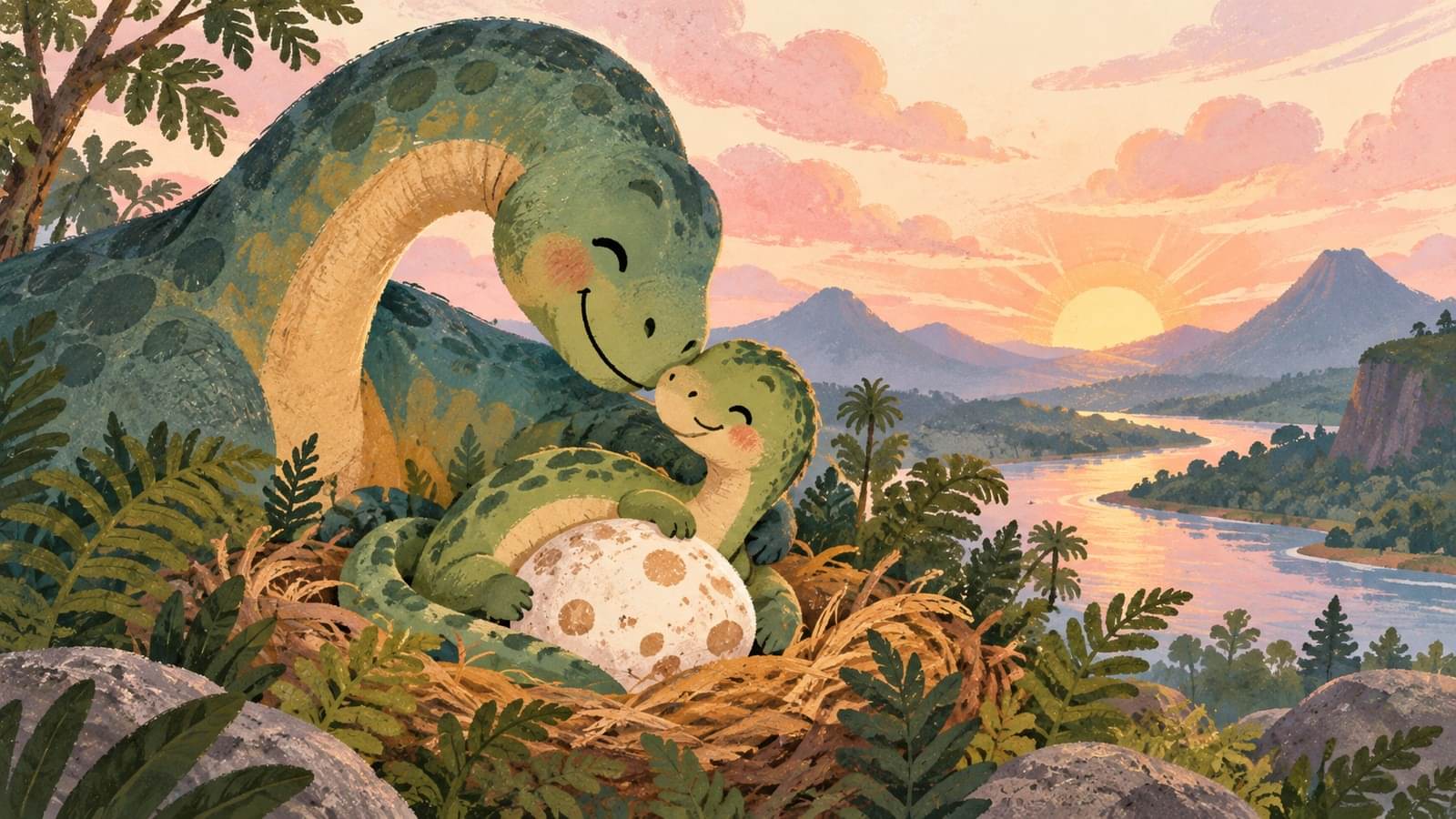
Tilly is a small dinosaur with a long neck, a long tail and a very loud opinion about everything, and every night of her life she has slept in the warm middle of the nest. Then the egg arrives, round and speckled and sitting right in her spot. “Eggs need the warm spot,” says Mama, “or they stop cooking.” Everybody comes to see it. Nobody says, “Ah, Tilly, lovely.” Something hot and prickly creeps up under Tilly’s chin.
On a cold, windy night she nudges the egg, just a little, and it rolls over the rim and bounces down the hill into the river. Tilly goes after it, sliding down the ferns, riding on the head of the great slow one, and searching a whole bank of speckled stones with the duckbill twins. She finds it by remembering what Mama said: every night, the egg knocks back. When she finds it, it is cold, so she lies down on the windy side and makes herself into a wall. “Hello, it’s me. I’m the one outside.”
It is gently funny, with a spell of night-time suspense, and it treats Tilly’s feelings as completely understandable. Nobody tells her off. The ending is the point: the warm spot turns out to be big enough for two. It is one of our longer stories, so it suits a night with a little time to spare. It also appears in our bedtime stories for 5-year-olds.
 The Egg Next to TillyTilly, a small dinosaur with a big opinion, has always slept in the warm middle of her family's fern-lined nest. When a speckled egg takes her spot and draws everyone's attention, she feels a little left out.Play the story
Five well-loved picture books about a new baby
These are widely recommended books from other publishers, described from their publishers’ and library catalogs. We have not linked to a shop.
- Peter’s Chair by Ezra Jack Keats (1967). Peter’s old cradle and high chair are being painted pink for his baby sister, Susie, so he rescues his little blue chair and runs away with it, as far as the front of the house. When he tries to sit in it, he is too big. He goes home and helps paint it for her. A quiet classic about growing up a little. Catalog
- Julius, the Baby of the World by Kevin Henkes (1990). Lilly the mouse thinks her new brother is disgusting, and says so, often. Then her cousin Garland says the same things about Julius, and Lilly furiously defends him. Funny and honest about jealousy, for slightly older siblings. A free read-aloud video is on Storyline Online. Catalog
- There’s Going to Be a Baby by John Burningham, illustrated by Helen Oxenbury (2010). A boy asks his mother question after question about the baby that is coming, and imagines what it might grow up to be. Good for the waiting months. Catalog
- I’m a Big Sister and I’m a Big Brother by Joanna Cole, illustrated by Rosalinda Kightley. Simple, reassuring books for ages 2 to 5 about what babies do and the good things about being older, with the message that the older child is as special as ever. Catalog
- The New Baby by Mercer Mayer (1983). Little Critter tries to help with his baby sister and finds she cannot do much yet. A light, familiar read for children who already know the series. Catalog
Choosing a story for your child
- Under 3: short, simple books that name things (baby, sister, brother) and show what babies do. I’m a Big Sister or I’m a Big Brother is a good start.
- 3 to 5: stories with a character who has feelings about the baby, such as Peter’s Chair or The Egg Next to Tilly.
- 5 and up: stories that can be funny about jealousy, such as Julius, the Baby of the World.
If your child loves Tilly, more of our stories with a lesson inside them are in bedtime stories with morals.
Frequently asked questions
When should I start reading books about a new baby?
A few months before the birth is a good time for most toddlers and preschoolers. Young children do not grasp months well, so link the books to something they can see coming, such as a season or a birthday, and keep reading them after the baby arrives, when the feelings tend to be biggest.
My child has started acting like a baby again. Is that normal?
Yes. The American Academy of Pediatrics describes a toilet-trained child having accidents or wanting a bottle after a new baby arrives as normal. Stay calm about it, keep their routines, and give them some time each day with you alone. HealthyChildren.org
Should the new baby change my older child's bedtime?
Try to keep the older child's bedtime the same, in the same order, with their own story. If you need to move them to a new bed or room, do it a few weeks before the baby is due, so the change does not arrive at the same moment as the baby. KidsHealth
References
- American Academy of Pediatrics. Preparing Your Older Child for a New Baby: How to Help Siblings Adjust. HealthyChildren.org, last updated February 10, 2026. Consulted October 2026.
- Nemours KidsHealth. Preparing Your Child for a New Sibling. Reviewed by KidsHealth medical experts. Consulted October 2026.
- Storyboat. Live published text and catalog entry for The Egg Next to Tilly. Plot, quoted lines, age range and narration duration checked October 2026.
- Book details from publisher and library catalog descriptions consulted October 2026: Keats, E. J. Peter’s Chair (Harper & Row, 1967); Henkes, K. Julius, the Baby of the World (Greenwillow Books, 1990); Burningham, J., and Oxenbury, H. There’s Going to Be a Baby (Candlewick Press, 2010); Cole, J., and Kightley, R. I’m a Big Sister and I’m a Big Brother (HarperCollins); Mayer, M. The New Baby (Golden Books, first published 1983).