
Bedtime routines · Ages 3–5, 6–8
Calm Bedtime Stories for Kids: 4 Gentle Stories to Wind Down
A yawn that travels the world, a train that delivers dreams, a lighthouse that answers a whale, and a star that needs the sky. Four gentle illustrated stories, and what makes a bedtime story calming.
Published 14 October 2026 · 6 min read
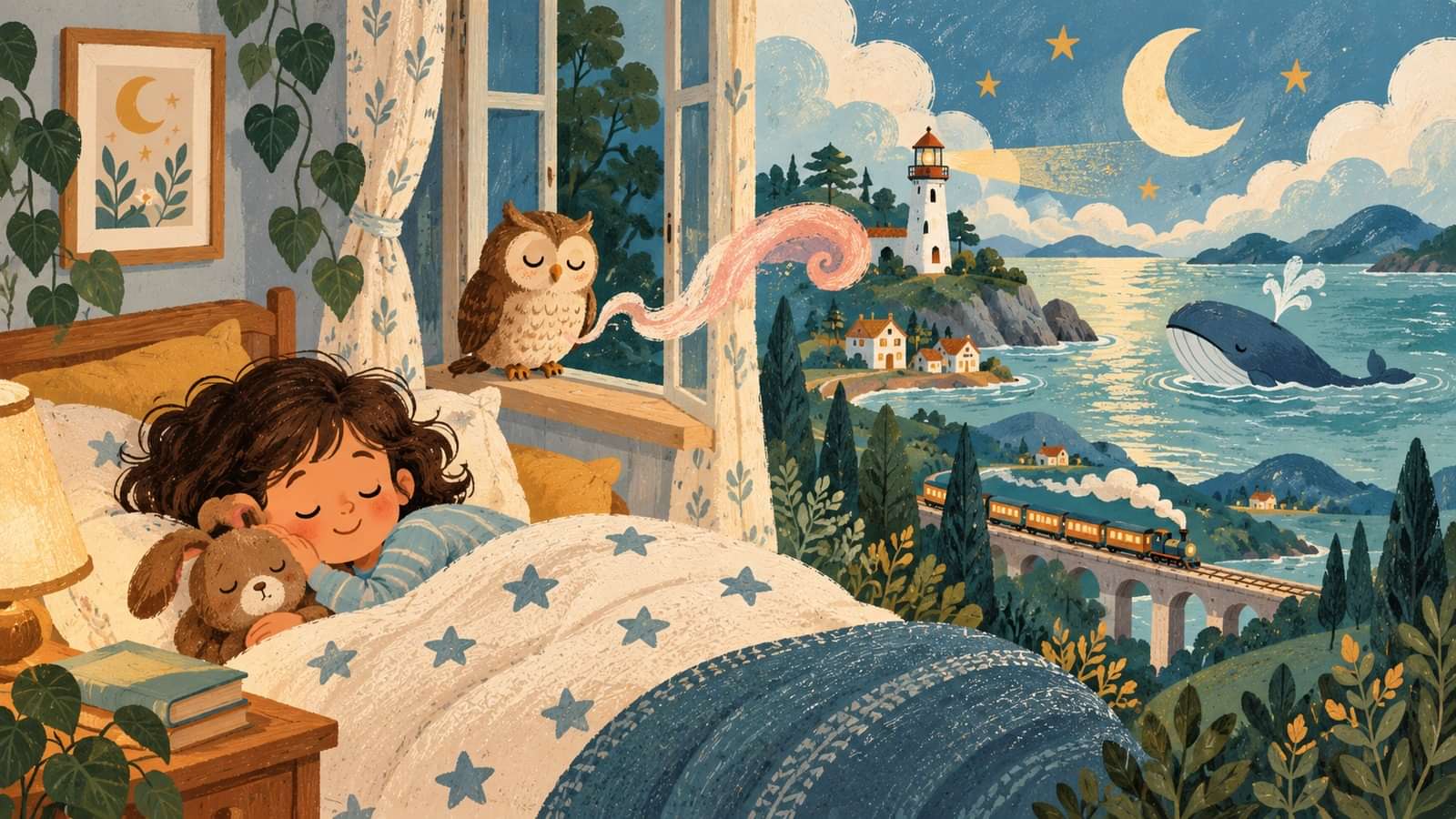
For a calm bedtime story, try The Wandering Yawn, The Dream Train, The Song from the Sea or The Star in the Jam Jar. Each moves slowly, repeats soft sounds you can read in a hush, and ends with its characters settling down to sleep. All four run under five minutes of narration, short enough to finish before eyes close.
These are selections from our own illustrated library. The links open each story page, where you can check its description, preview and current availability. Age recommendations were checked in October 2026.
What makes a bedtime story calming
This is editorial guidance rather than a rule, but calm stories tend to share five things:
- An unhurried pace. Short sentences and small events, one after another, with room to breathe between them.
- Repetition and soft sounds. A line or a sound that comes back (shhh-tk, blink, blink, Yaaawn!) is soothing to hear and easy to read quietly.
- A small problem, solved gently. Something to wonder about, but nothing that needs a hero to fight it.
- An ending that settles. Lights go low, characters curl up, and the last lines often turn to the listener.
- A length you can finish. A story that ends is easier to stop than one that leaves a cliffhanger. Our guide to bedtime stories by age covers how long a story can be at each age.
What to leave for daytime: chases, big fights and frightening new creatures. The American Academy of Pediatrics notes that 3- and 4-year-olds often cannot tell fantasy from reality and may imagine unfamiliar images as monsters. AAP, 3 to 4 years
The Wandering Yawn: the sleepiest story we have
Recommended ages: 3–6 · Narration: 3 minutes 39 seconds
At the end of a very good day, a little mouse yawns, and the yawn sets off without her. It drifts to an owl in an oak tree (“How silly, owls do not…”), a camel in the desert, a striped cat, a great blue whale and a monkey who forgets to grab the next branch. One by one they fall asleep, the lights go out behind the yawn, and it slips through an open window to land on the listener.
It is the most direct of the four: the story is about getting sleepy, and it ends by talking to your child (“Now close your eyes”). Expect a few yawns of your own. It suits the youngest listeners best.
 The Wandering YawnA tiny mouse’s yawn drifts from fields to sea, desert, and jungle, making animals everywhere sleepy. Will it find one more cozy listener before the whole wide night grows quiet?Play the story
The Dream Train: a whole valley tucked in
Recommended ages: 3–7 · Narration: 4 minutes 30 seconds
Conductor Badger drives a midnight-blue train whose wheels never clatter. They go shhh-tk, shhh-tk. He delivers wrapped dreams to otters, hares and an old tortoise, until one parcel turns up with no name on it. The search takes him past every sleeping den in the valley, and the parcel turns out to be for the only one still awake: Badger himself. The moon takes the driver’s seat while he climbs into a bed he has never used.
The mystery is small and kind, and the ending puts everyone to bed, including your child (“Then the whole world gets to sleep, even you”). Good for train lovers.
 The Dream TrainEach night, Conductor Badger guides the whisper-quiet Dream Train through a sleeping valley, delivering carefully wrapped dreams to its animal residents. But one starry parcel has no label, sending Badger on a gentle search for its rightful sleeper.Play the story
The Song from the Sea: a lamp turned down low
Recommended ages: 4–8 · Narration: 4 minutes 12 seconds
Wren lives at the top of a little white lighthouse with her grandpa. One night she hears a slow, lonely song from under the waves that nobody else can hear. She cannot answer with her small voice, so she answers with the lamp: long blink, short blink, long blink. Night after night the song comes closer, until a great blue whale rises in the bay and settles beside the rock to sleep, and Wren and Grandpa turn the lamp low for her.
There is one moment of suspense as something huge rises from the water, and it resolves into the gentlest ending of the four. Choose it for a child who loves the sea, or who sometimes feels nobody is listening.
 The Song from the SeaAt a little sea lighthouse, Wren hears a lonely song beneath the waves. With her grandfather’s lamp, she finds a gentle way to answer the mysterious singer.Play the story
The Star in the Jam Jar: a little sadness, then sky
Recommended ages: 4–8 · Narration: 3 minutes 32 seconds
In Amaya’s village, Grandmother knits the night sky each evening, tick, tick, tick. When she sneezes and drops a stitch, a small star tumbles into the mango tree. Amaya keeps it safe in a jam jar by her bed, but each night it shines a little less. “Fish need water, and stars need sky,” says Grandmother, and together they knit it back into the night.
It is quiet and tender, with a moment of real sadness when Amaya lets go, so check the premise if your child finds goodbyes hard. It ends with a goodnight to the brightest star outside the window.
 The Star in the Jam JarWhen Grandmother’s knitted sky drops a tiny star into Amaya’s garden, she keeps it safe in a jam jar, and learns what a friend needs to shine.Play the story
Making the story part of winding down
- Read a little slower and quieter as you go. Let your voice drop for the last page.
- Keep it in the same place in the routine, after teeth and pajamas, so the story becomes the signal that sleep comes next. The AAP recommends a regular bedtime routine. AAP, healthy sleep habits Our simple bedtime routine shows one way to order it.
- Agree on one story before you start. If “one more” is a nightly negotiation, our guide to when your child asks for one more story has phrases that help.
- Let the ending be the ending. In Storyboat, the background music plays on after The End for a time you choose (10 minutes unless you change it), then fades out, so nobody has to reach for the screen to make the room quiet.
For more gentle choices with a different focus, see our bedtime stories about kindness.
Frequently asked questions
What is a good calm bedtime story?
Look for a slow pace, soft repeated sounds, a small problem solved early, and an ending where the characters settle down to sleep. The Wandering Yawn, The Dream Train, The Song from the Sea and The Star in the Jam Jar all work this way.
Do calm bedtime stories help kids fall asleep?
No story is a sleep treatment. A calm story works best as one familiar step in a regular bedtime routine, which the American Academy of Pediatrics recommends. If your child often has trouble falling asleep, talk to their doctor. AAP, healthy sleep habits
What should I avoid in a bedtime story?
Skip chases, cliffhangers and frightening new creatures right before sleep, and save the most exciting adventures for earlier in the evening. Young children do not always separate make-believe from real life, and an unfamiliar shape in a picture can easily become a monster. AAP, 3 to 4 years
References
- Storyboat. Live published text and catalog entries for The Wandering Yawn, The Dream Train, The Song from the Sea and The Star in the Jam Jar. Plots, quoted lines, ages and narration durations checked October 2026. The “calming” features are editorial description, not a measured effect.
- American Academy of Pediatrics. Developmental Milestones: 3 to 4 Year Olds. HealthyChildren.org; parent guidance, last updated April 2023; accessed October 2026.
- American Academy of Pediatrics. Healthy Sleep Habits: How Many Hours Does Your Child Need?. Recommendations on regular routines and when to talk to a doctor; accessed October 2026.