
Comprehension · Ages 2–3, 4–5, 6–8
Help Your Child Retell a Story Without Testing Them
Keep the book open, choose one favorite scene, and share the telling. Simple phrases and an optional picture activity to try together.
Published 16 September 2026 · 4 min read
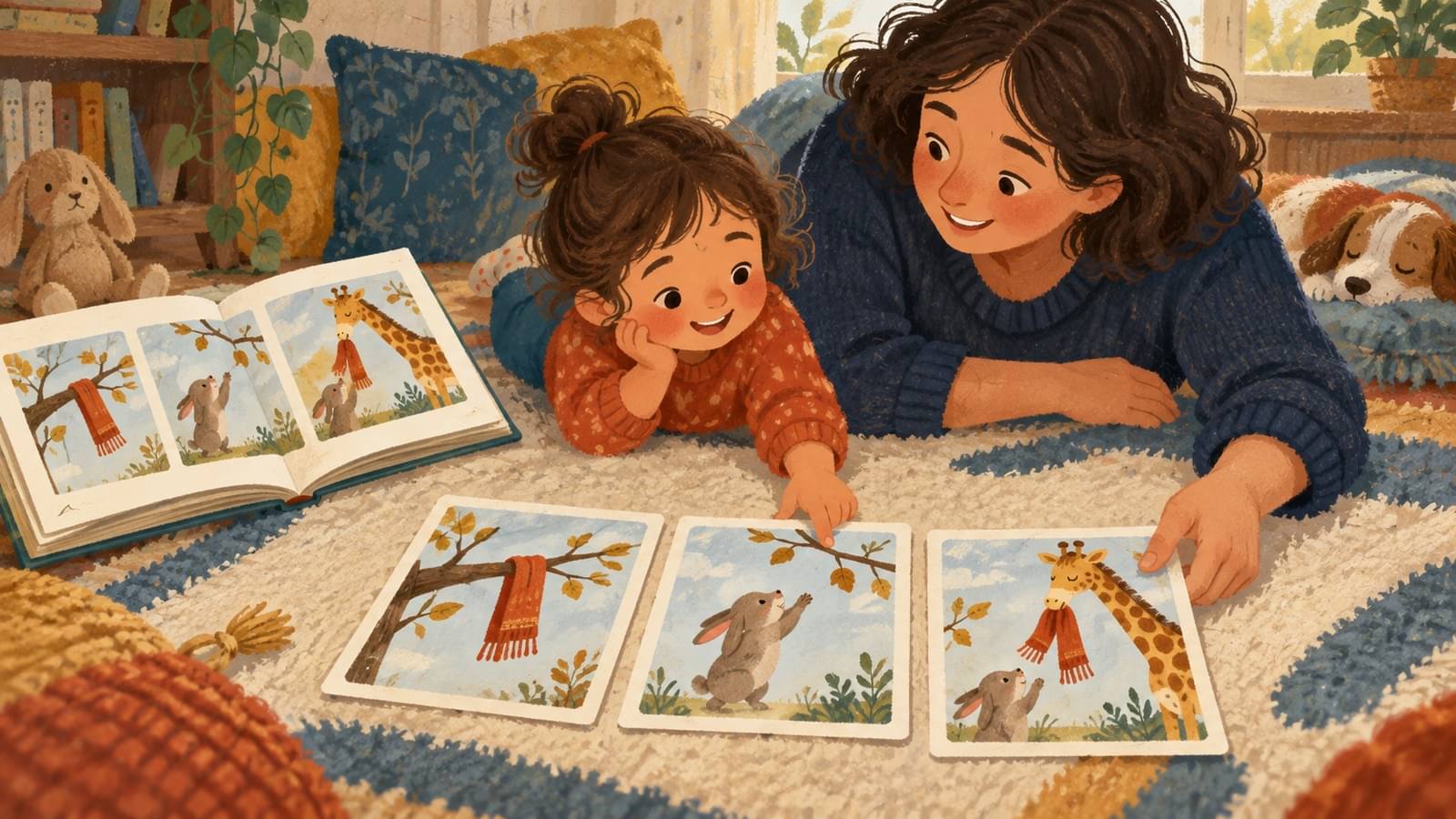
To help your child retell a story, keep the book open, choose one short scene, and start telling it together. Try: “I'll tell the first bit, and you can show me what happened next.” Pictures, toys, and your own words can help; your child does not need to remember everything alone.
“Tell me the whole story” is a big request. A smaller invitation gives you both a clear place to begin and finish. The phrases below are examples you can adapt, not a script to work through.
Choose one scene they enjoyed
Start with a funny moment or a character your child mentions. You might say, “Let's tell the part where Benny gets stuck.”
In Benny and the Fox, recommended for ages 3–6, Benny tries to squeeze through a narrow gap, gets stuck, and eventually wriggles out. That small episode is enough for a shared retelling. You do not need to cover every visit or conversation in the story.
For a younger child, choose a familiar, age-appropriate picture book and point to one event.
Leave the pictures where they can see them
Open the book at the scene you are discussing. Point to the character and offer a starting sentence: “Benny followed Finn toward the gap…”
Then pause. Your child might add a word, act out getting stuck, or turn to the next picture. You can finish the sentence if they prefer to watch.
There is no need to close the book to check whether they can do it from memory. The pictures are part of the help you are offering.
Share the telling
Here is an invented example:
Rabbit's scarf blows onto a branch. She cannot reach it, so Giraffe lifts it down.
You could begin, “Rabbit wanted her scarf, but it was up in the tree.” Your child can reach upward while you continue: “She asked Giraffe for help.”
If they say only “Giraffe!”, build on it: “Yes, Giraffe reached the scarf.” A contribution does not have to be a full sentence to become part of your shared telling.
Our reading-aloud tips offer more ways to respond to what your child gives you.
Help with the order without correcting every detail
If your child starts with the ending, acknowledge it: “Yes, she got her scarf back.” Then offer the earlier event: “Before that, the wind blew it into the tree.”
Use “first,” “then,” or “because” in your own sentences when they help. You can keep the account clear without stopping every time a small detail changes.
If a new character appears in their version, decide together whether you are remembering the book or inventing a different story. Both can be enjoyable. “A whale could rescue it in our new version. In the book, Giraffe helped.”
Try it together · Storyboat
Optional: tell it with three pictures
Draw three quick pictures: the scarf on the branch, Rabbit reaching, and Giraffe handing it back. Or choose three moments from a story you already know.
Place the pictures in order together. Tell the scene while your child points, moves a toy, or adds a phrase. They can also tell it to a favorite stuffed animal with your help.
Keep the pictures if they want another turn. There is nothing to finish or score.
Stop when the invitation stops being fun
Retelling does not need to follow every reading. If your child asks for the next book or says they are finished, let the story end.
A tired evening is not a useful moment to draw conclusions about their abilities. Notice what helped you share this scene, such as an open picture or a starting sentence, and use it again when they are interested.
For the difference between remembering details and connecting events, see how children understand stories.
What the research adds
A small study of five preschoolers with narrative-language delays reported improvements after a structured classroom intervention. That targeted work is different from casually retelling a story at home; the published abstract does not establish results for our picture activity. Study abstract
The IES school guidance also supports teaching text structure, with moderate evidence for that broader recommendation. It does not prescribe this three-picture exercise for families. IES practice guide
Use retelling as another way to enjoy a familiar story together. You can do as much of the telling as your child needs.
References
- Spencer, T. D., & Slocum, T. A. (2010). The Effect of a Narrative Intervention on Story Retelling and Personal Story Generation Skills of Preschoolers With Risk Factors and Narrative Language Delays. Journal of Early Intervention, 32(3), 178–199. DOI: 10.1177/1053815110379124. Published abstract consulted; five participants in a targeted classroom intervention.
- Shanahan, T., et al. (2010). Improving Reading Comprehension in Kindergarten Through 3rd Grade. Institute of Education Sciences, NCEE 2010-4038. Recommendation 2 and its Appendix D evidence discussion consulted.