
Language & learning · Ages 3–5, 6–8
Read-Along Stories for Kids: How Highlighted Words Help, and Where to Find Them
Read-along stories light up each word as a narrator reads it. What the research says about highlighted words, how to use them with a child who is learning to read, and three stories with repeated lines to follow.
Published 14 October 2026 · 8 min read
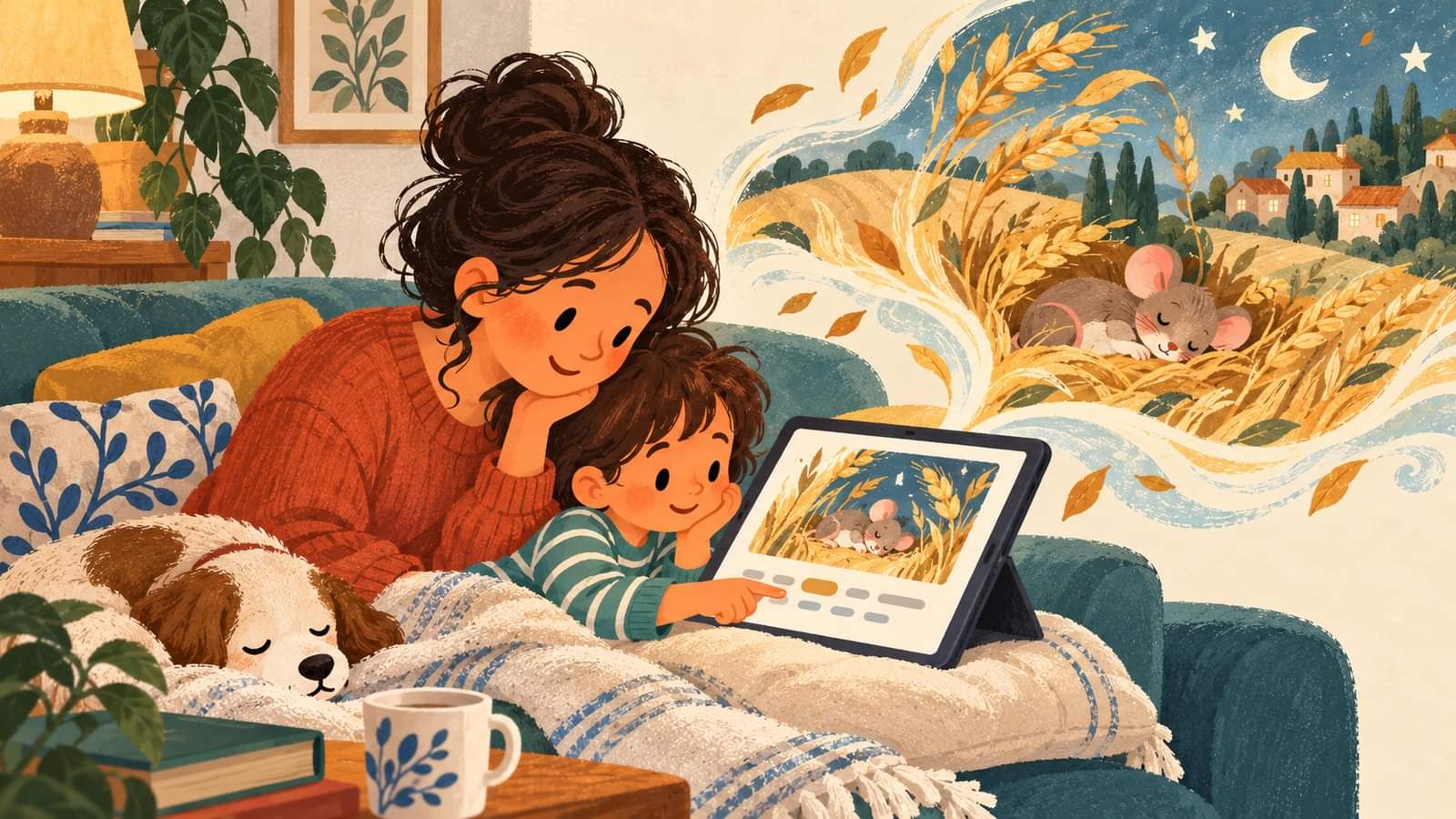
Read-along stories show the words while a narrator reads them, lighting up each word as it is spoken, so your child can follow the print. They can help a child aged about 4 to 7 notice words, especially when you reread a story with a repeated line and pause to let them join in. To find them, try Storyboat’s Play mode, Vooks, Epic’s Read-To-Me books or your library’s read-alongs in Libby.
Why highlighted words can help
When you share a picture book aloud, your child is mostly looking at the pictures. In a small eye-tracking study, four preschoolers spent about 2.5% of their looking time on the print while an adult shared a book with them. Justice and colleagues, 2005 That makes sense: the pictures tell them the story, and the black marks underneath do not mean anything yet.
Highlighting gives the words a reason to be looked at. In a study of 61 kindergartners aged 4 and 5, electronic storybooks that lit up each word in time with the narration raised the share of time children spent looking at the print from about 19% to 38%. After four weeks, print awareness had improved in that group, and in a group whose storybooks pointed the print out explicitly. Liao and colleagues, 2020
Two limits are worth keeping in mind. Print awareness, knowing that print carries the words and runs left to right, is an early step, not reading itself. And the same study found that pointing the print out explicitly helped too, which is something you can do yourself with a finger under the words, so an app is one way to draw attention to print, not the only one. A review of 43 studies found that narrated storybooks with pictures and music gave a small extra benefit for story understanding and vocabulary, while add-ons such as games and hotspots tended to distract. Takacs, Swart and Bus, 2015
How to use read-along stories at home
- Choose a short story with a repeated line. A word that comes back again and again is the easiest one for a child to spot and say.
- Enjoy it once without teaching anything. Let the narrator tell it and let your child follow the pictures. The story comes first.
- On a reread, pause before the repeated word. “Then the camel went…” Let your child say it while it lights up.
- Point now and then. Run a finger under a line, or ask “Where does it say yawn?” Once or twice a story is plenty.
- Swap the narrator for you. Turn the narration off and be the voice yourself, leaving the repeated line for your child. Bigger text helps here.
- Stop before it feels like a lesson. If your child would rather just listen tonight, let them. Our reading-aloud tips show how to follow their lead without quizzing.
The example phrases above are illustrative, not a script.
Three stories with lines to follow
These are from our own illustrated library. Each one has a line that repeats, which makes it a good first story to follow along with. Links open the story page, where you can check its description, preview and current availability.
The Wandering Yawn: a word that changes size
Recommended ages: 3–6 · Narration: 3 minutes 39 seconds
A tiny mouse yawns at the end of a very good day, and the yawn sets off around the world: to an owl, a camel, a cat, a whale and a monkey, and finally through an open window to the listener. The word changes size with whoever catches it, from the mouse’s small Yaaawn! to a whale-sized YAAAAAAAAAWN!, which is a lovely thing for a young child to watch light up and copy. It is also one of our calmest stories.
 The Wandering YawnA tiny mouse’s yawn drifts from fields to sea, desert, and jungle, making animals everywhere sleepy. Will it find one more cozy listener before the whole wide night grows quiet?Play the story
Bramble’s Bakery: counting along
Recommended ages: 3–7 · Narration: 4 minutes 9 seconds
Bramble the bear bakes only for himself until a small bird called Pip keeps visiting his windowsill. Each morning he gives in a little more: “One bun,” then “Two buns,” then “Three buns,” always insisting that is all. A child who knows their numbers can say the count before the narrator does, and the joke of Bramble’s “absolutely no more” lands every time.
 Bramble's BakeryBramble the bear loves baking warm breads and berry tarts, but prefers to keep every crumb to himself. When a curious little bird begins visiting his windowsill, his quiet kitchen starts to feel different.Play the story
Benny and the Fox: the same question every morning
Recommended ages: 3–6 · Narration: 4 minutes 47 seconds
Benny the baby elephant asks a fox to be friends, and every morning the answer is no, with a new reason why. Benny tries to keep up, and ends up in a puddle, stuck between two rocks, and crashing through the bushes. The repeated question, the fox’s “No” and Benny’s “Why?” are short words a beginning reader can catch, and the ending changes the answer.
 Benny and the FoxFriendly Benny the elephant keeps meeting a speedy, sneaky little fox, discovering through muddy mishaps and laughter that friendship can grow between the most different animals.Play the story
Where to find read-along stories
- Storyboat. Original illustrated stories for ages 3 to 8, one illustration and one sentence at a time. Play mode reads each line aloud and lights up every word as it is spoken; Read mode turns the narration off so you or your child can be the voice. You can make the words bigger, or choose First reader, a typeface drawn for children learning to read, with simple letter shapes that are easy to tell apart. Storyboat
- Vooks. Gently animated picture books with narration and text that highlights the words, by subscription. Vooks
- Epic. Read-To-Me books with voice actors, plus Spotlight Words and an audio dictionary for new vocabulary, by subscription. Epic
- Libby. Free with a library card; its listing describes interactive read-alongs to share with your children, where your library has them. Libby
- Google Read Along. Free on Android and the web. Here your child does the reading aloud, and a reading buddy listens and helps with pronunciation, which suits a child who is already decoding words. Google Read Along
For a side-by-side comparison of these and other options, see our Vooks alternatives.
What to look for in a read-along app
- Words that light up one at a time, in time with the voice. A whole line lighting up at once does not show which word is which.
- Text big enough to see from where your child sits.
- A way to turn the narration off, so the story can become one you share.
- Few extras. Games, hotspots and pop-ups compete with the words for your child’s attention.
- A story that ends. An app that rolls straight into the next story is harder to stop at bedtime.
If reading aloud yourself is the bigger part of your evenings, our guide to the benefits of reading aloud to children covers what the research supports there.
Frequently asked questions
What are read-along stories?
Read-along stories show the words of a story on screen or on the page while a narrator reads them aloud. In most read-along apps each word lights up as it is spoken, so a child can follow the print with their eyes.
Do read-along stories help kids learn to read?
They can help a child notice print. Children listening to a picture book look mostly at the pictures, and in one study of 4- and 5-year-olds, highlighting each word as it was spoken doubled the time they spent looking at the text and improved their print awareness over four weeks. That is not the same as teaching a child to read, so read-alongs work best alongside reading together. Liao and colleagues, 2020
What app reads to my child and highlights the words?
Storyboat's Play mode reads each sentence aloud and lights up every word as it is spoken, and Read mode turns the narration off so you can be the voice. Vooks animates picture books with read-along text. Epic has Read-To-Me books, and Libby lends read-alongs where your library has them.
What age are read-along stories for?
Most are made for children aged about 3 to 8. A 3-year-old will mostly enjoy the story and pictures. From about 4 or 5, when children start noticing letters, following the highlighted words gives them a reason to look at the print.
References
- Justice, L. M., Skibbe, L., Canning, A., & Lankford, C. (2005). Pre-schoolers, print and storybooks: An observational study using eye movement analysis. Journal of Research in Reading, 28(3), 229–243. https://doi.org/10.1111/j.1467-9817.2005.00267.x. Study details as reported in later literature and the publisher record; full text not reviewed. Four children, so treat it as an illustration rather than a general measure.
- Liao, C. N., Chang, K. E., Huang, Y. C., & Sung, Y. T. (2020). Electronic storybook design, kindergartners’ visual attention, and print awareness: An eye-tracking investigation. Computers & Education, 144, 103703. https://doi.org/10.1016/j.compedu.2019.103703. Abstract consulted. 61 children aged 4–5 in Taiwan, randomly assigned to three conditions over a four-week intervention.
- Takacs, Z. K., Swart, E. K., & Bus, A. G. (2015). Benefits and pitfalls of multimedia and interactive features in technology-enhanced storybooks: A meta-analysis. Review of Educational Research, 85(4), 698–739. https://doi.org/10.3102/0034654314566989. Abstract consulted. 43 studies, 2,147 children.
- Storyboat. Story library, The Wandering Yawn, Bramble’s Bakery and Benny and the Fox. Live story text, ages and narration durations, and the player’s word highlighting and caption settings, checked October 2026. First-party description.
- Vooks. Animated Storybooks for Kids. Consulted October 2026.
- Epic. Epic: Kids’ Books & Reading on the App Store. Consulted October 2026.
- OverDrive. Libby, the library app on the App Store. Consulted October 2026.
- Google. Read Along. Consulted October 2026.