
Reading habits · Ages 3–5, 6–8
How to Make Up a Bedtime Story: A 5-Step Recipe for Tired Parents
A simple five-step recipe for making up a bedtime story on the spot: a character, something they want, a small trouble, a helper, and an ending that walks back down to sleep. With a worked example and what to leave out at night.
Published 20 October 2026 · 8 min read
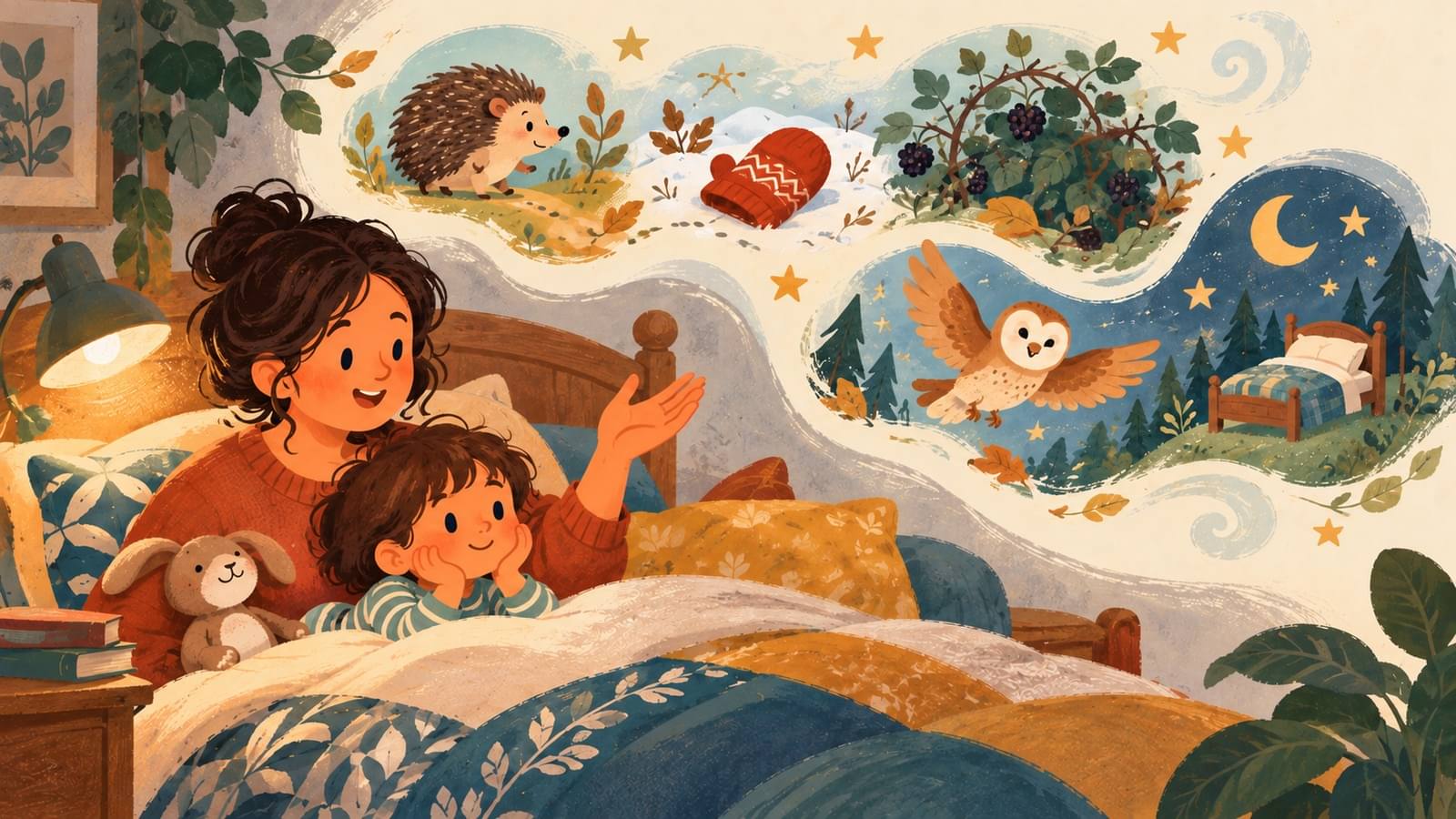
To make up a bedtime story, you only need five pieces: a character, something they want, a small trouble, someone who helps, and an ending that walks back down to bed. Fill in each piece in a sentence or two and you have a three-minute story. The fifth piece is what makes it a bedtime story rather than an adventure told at night: the energy rises a little in the middle, then comes down to somewhere warm and quiet.
You do not need to be a good storyteller, and you do not need to plan anything. Below are the five steps, a worked example built from them, what to leave out at night, and ways to share the telling with your child.
The five-step bedtime story recipe
- A character. Small and specific beats grand. “A hedgehog called Pim” is easier to tell than “a brave knight”. Your child’s favourite animal or toy is a ready-made hero.
- Something they want. One plain want: to find a lost mitten, to see the sea, to get home before dark, to make a new friend. The want is what the whole story is about, so say it out loud early.
- A small trouble. Something gets in the way, but nothing a child would lie awake about. A river too wide to cross, a door that will not open, a friend who says no. Keep the stakes tiny: a lost mitten is a better bedtime problem than a lost child.
- A helper. Somebody kind, or clever, or very slow, helps the character solve it. Helpers do a lot of work in a made-up story. They give you a fresh scene when you are stuck, and they let the character succeed without anyone being defeated.
- An ending that walks back down. The want is met, and then the story keeps going a little after the excitement, getting slower and softer: the walk home, the lights going out, the character curling up to sleep. End on the same line every night if you like (“And then it was time to sleep”). A familiar last line works like a full stop for the whole day.
If you remember only one rule, make it the fifth. A story that ends on its exciting moment leaves a child wound up. A story that ends on a yawn hands them to sleep.
A worked example, built from the recipe
This example is illustrative, invented for this guide. It takes about three minutes to tell.
Character: Once upon a time there was a hedgehog called Pim who lived under the roots of a big oak tree.
Want: Every winter Pim wore one red mitten on his nose, because his nose got cold. But one morning, the mitten was gone.
Trouble: Pim looked under leaves and inside acorn cups. He looked in the puddle and in the moss. He even looked in his own ear. No mitten. And the wind was getting colder.
Helper: High in the oak, Owl had been watching. “Hoo,” said Owl. “Is it red? Is it woolly? Is it being used as a bed by three small mice?” It was. The mice were very sorry. Pim was very kind. He said they could keep it, if Owl could help him find something else for his nose. Owl brought him a feather. It was the warmest nose-warmer a hedgehog ever had.
Walking back down: Pim walked home slowly under the oak. The mice were already asleep in the mitten. Owl closed her big round eyes. Pim curled up into a little round ball, tucked his feathered nose into his tummy, and went to sleep. And then it was time for everyone to sleep.
Notice how little there is: one want, one trouble, one helper. The trouble is solved by kindness, nobody is the villain, and more than a third of the telling happens after the problem is solved. That last stretch is where you slow your voice down.
What to leave out at night
- Cliffhangers. “To be continued” is lovely for a series, but say how tonight’s part ended before you stop: Pim is home and asleep, and tomorrow he will meet the mice again.
- Real danger. Chases, monsters that stay scary, getting lost from a grown-up. Save them for daytime, or turn them into something funny, as a duck becomes a sea monster in The Great Puddle Voyage and then turns out to be only a duck.
- Too many characters. Two or three is plenty. Every new character is a name your child has to hold onto at the end of a long day.
- A moral at the end. If the story is about kindness, Pim being kind is enough. Saying “and that is why we share” replaces the feeling with a lesson.
- Questions that test. Asking “what happened next?” is fine if your child wants to join in, but a story is not a quiz. See our reading aloud tips for ways to invite talk without testing.
Telling it together
Children often want to help. A few ways to share the work:
- They pick, you tell. Ask for just the character and the want (“a dinosaur who wants a hat”) and tell the rest yourself.
- One sentence each. Take turns adding a sentence. Keep the fifth step for yourself, so you can steer the ending home.
- The recurring hero. Bring the same character back every night with a new small trouble. Your child gets the comfort of a familiar friend and you only invent one scene.
- Their day, retold. Turn something that happened today into the trouble, gently changed: the long wait at the doctor becomes a squirrel waiting for the rain to stop.
Telling stories rather than reading them is a fine thing to do for its own sake. In one study of children aged 3 to 5, both hearing stories told and hearing them read from a book produced gains in oral language; the children who heard them told retold the stories with better comprehension, while those who heard them read used more complex language. Isbell et al., 2004 So there is no need to choose: a made-up story one night and a book the next is a good mix.
Try it together · Storyboat
Optional: a story recipe card for the bedside
Write the five steps down the side of a card, with a space beside each one. Before bed, let your child fill in one or two spaces with a word or a drawing: a character, or the thing they want. You fill in the rest as you tell it.
- Who is the story about? ____________
- What do they want? ____________
- What gets in the way? ____________
- Who helps? ____________
- Where do they fall asleep? ____________
Keep the cards. On a tired night, pick one up and tell it again.
When you have nothing left
Some nights the recipe is one step too many. That is what the stories you already know are for. A story you can see working is also a good model of the shape. In The Dream Train, Conductor Badger delivers a dream to every sleeping animal in the valley, finds one parcel with no name on it, and slowly realises it is for him. The trouble is small, the helper is the moon, and the last few minutes are all slowing down: Badger climbs into a bed he has never used, and the wheels go shhh-tk, shhh-tk.
If you would like ready-made starting points instead of a method, our list of bedtime story ideas has prompts grouped by what your child loves and by the kind of night you are having. For what makes a story wind a child down rather than up, see calm bedtime stories.
Frequently asked questions
How long should a made-up bedtime story be?
Three to five minutes is plenty for most children aged 3 to 8. That is roughly the length of a short picture book read aloud. A made-up story can always continue tomorrow, which is often a better ending than one more twist tonight.
What if my child keeps changing the story?
Let them, within the recipe. If they add a dragon, the dragon can be the helper. If they want the trouble to get bigger, say the trouble gets bigger tomorrow night, and steer tonight's version back toward home and bed.
Can I tell the same made-up story every night?
Yes. Many children love a recurring character, and repeating a story is an ordinary thing for them to ask for. Keep the character and the ending the same and change only the small trouble, so the story feels new without you having to invent a whole world. If your child asks for the same story night after night, our guide to why children want the same story again explains why that is a good sign.
References
- Isbell, R., Sobol, J., Lindauer, L., & Lowrance, A. (2004). The effects of storytelling and story reading on the oral language complexity and story comprehension of young children. Early Childhood Education Journal, 32(3), 157–163. doi:10.1023/B:ECEJ.0000048967.94189.a3. Abstract consulted via ERIC (EJ732281), October 2026.
- Storyboat. Live published text of The Dream Train and The Great Puddle Voyage, checked October 2026. The five-step recipe and the worked example are editorial guidance, not a tested method.